
End-to-End Process Control from Seed to Shipment

The Gold Standard: Understanding Pharmaceutical Grade Castor Oil (USP/BP)

Introduction:

In the world of pharmaceuticals and healthcare, precision, purity, and safety are paramount. Every ingredient used in medicinal products must meet rigorous standards to ensure efficacy and patient well-being. This is particularly true for Pharmaceutical Grade Castor Oil, which adheres to strict specifications set by pharmacopeias like the United States Pharmacopeia (USP) and British Pharmacopoeia (BP). But what makes this grade so critical, and where does it play a vital role? Let’s explore.

What is Pharmaceutical Grade Castor Oil (USP/BP)?

Pharmaceutical Grade Castor Oil is a highly refined and purified form of castor oil specifically processed to meet the exacting quality and purity standards outlined in official pharmacopeias such as USP (United States Pharmacopeia) and BP (British Pharmacopoeia). These monographs detail specific tests, limits for impurities, and analytical methods that the oil must pass to be deemed “pharmaceutical grade.” This ensures it is safe and suitable for use in human and animal health applications.

Key Characteristics and Why They Matter:

  • Exceptional Purity: The most defining characteristic is its extremely low level of impurities. This includes minimal heavy metals, residual solvents, and other undesirable substances that could compromise drug stability or patient safety.
  • Consistent Quality & Composition: USP/BP standards dictate a precise range for the oil’s chemical composition, ensuring that each batch behaves predictably in formulations and has consistent therapeutic effects.
  • Traceability and Documentation: Manufacturers of pharmaceutical grade castor oil provide extensive documentation, including Certificates of Analysis (CoA), confirming adherence to pharmacopeial standards. This traceability is essential for regulatory compliance.
  • Controlled Manufacturing Environment: Production typically occurs in facilities that follow Good Manufacturing Practices (GMP), minimizing contamination risks throughout the extraction, refining, and packaging processes.

Applications in Pharmaceuticals and Healthcare:

The stringent quality of Pharmaceutical Grade Castor Oil makes it indispensable in various medical and health applications:

  • Excipient in Oral Formulations: It serves as a solvent, emulsifier, or lubricant in soft gelatin capsules, tablets, and liquid medications, helping to dissolve active pharmaceutical ingredients (APIs) or improve their bioavailability.
  • Topical Preparations: Its emollient and soothing properties make it a common ingredient in dermatological creams, ointments, and balms, particularly for wound care, dry skin conditions, and eye drops.
  • Ophthalmic Preparations: Due to its purity and low irritation potential, it is used in certain eye drop formulations.
  • Specialized Drug Delivery Systems: Its unique properties can be leveraged in advanced drug delivery systems, including controlled-release formulations.
  • Veterinary Medicines: Similar to human applications, it is used in various veterinary pharmaceutical formulations.

Why Choose Our Pharmaceutical Grade Castor Oil (USP/BP)?

When it comes to human and animal health, there is no room for compromise. Our Pharmaceutical Grade Castor Oil is meticulously manufactured and tested to meet or exceed USP and BP specifications. We are a trusted partner for pharmaceutical companies, offering a reliable supply of this critical excipient, backed by comprehensive quality control and regulatory support.

Conclusion:

Pharmaceutical Grade Castor Oil (USP/BP) is a cornerstone ingredient in the healthcare industry, embodying the highest standards of purity and quality. Its essential role in drug formulations, topical treatments, and specialized medical applications underscores the importance of choosing a supplier who understands and adheres to these critical pharmacopeial requirements. Elevate the safety and efficacy of your products with our premium pharmaceutical grade castor oil.


Relevant Keywords for Pharmaceutical Grade Castor Oil (USP/BP):


Primary Keywords:

  • Pharmaceutical Grade Castor Oil
  • Castor Oil USP
  • Castor Oil BP
  • USP/BP Castor Oil
  • Pharma Grade Castor Oil

Secondary Keywords:

  • Excipient castor oil
  • Pharmaceutical excipients
  • Medical grade castor oil
  • Castor oil for drugs
  • Castor oil in formulations
  • USP standards castor oil
  • BP standards castor oil
  • High purity castor oil
  • Castor oil for capsules
  • Topical castor oil
  • Ophthalmic castor oil
  • Drug delivery systems castor oil
  • GMP castor oil
  • Regulatory compliant castor oil
  • Pharmaceutical raw materials

Long-Tail Keywords/Phrases:

  • Benefits of pharmaceutical grade castor oil in medicine
  • Where to buy USP BP castor oil
  • Castor oil excipient properties in pharmaceuticals
  • Quality control for pharmaceutical grade castor oil
  • Castor oil for ophthalmic solutions
  • Castor oil as a solvent in drug formulations
  • Suppliers of USP/BP grade castor oil
  • Importance of purity in pharmaceutical castor oil
Unveiling the Versatility of Castor Oil FSG: Your Go-To for Industrial Excellence

Introduction:

Castor oil has been a staple in various industries for centuries, celebrated for its unique chemical composition and myriad applications. Among its diverse forms, Castor Oil FSG stands out as a premium grade, offering unparalleled quality and performance. But what exactly is FSG, and why is it the preferred choice for so many industrial needs? Let’s dive in.

What is Castor Oil FSG?

FSG stands for “First Special Grade,” indicating a superior quality of castor oil that meets stringent purity and performance standards. It is carefully processed to ensure a consistent composition, making it highly reliable for sensitive applications. Unlike general-purpose castor oils, FSG boasts specific characteristics that make it ideal for demanding industrial processes.

Key Characteristics and Benefits:

  • Exceptional Purity: Castor Oil FSG undergoes meticulous refining to remove impurities, resulting in a cleaner product. This purity is crucial in applications where even minor contaminants can affect performance.
  • Consistent Quality: With FSG, you can expect a uniform product batch after batch. This consistency is vital for manufacturers who rely on predictable material properties in their production lines.
  • High Ricinoleic Acid Content: The high concentration of ricinoleic acid, a unique fatty acid, gives castor oil its distinctive properties, including excellent lubricity, solvency, and moisturizing capabilities. In FSG grade, this content is optimized for industrial effectiveness.
  • Biodegradable and Renewable: As a natural vegetable oil, Castor Oil FSG is an eco-friendly choice, offering a sustainable alternative to petroleum-based chemicals.

Applications Across Industries:

The versatility of Castor Oil FSG makes it indispensable in a wide array of sectors:

  • Cosmetics and Personal Care: Its emollient properties make it a popular ingredient in soaps, lotions, and hair care products, providing deep hydration and a smooth feel.
  • Pharmaceuticals: While we offer a pharmaceutical grade, FSG can be a base or an excipient in certain non-active formulations due to its purity.
  • Lubricants and Greases: Its excellent lubricating properties make it suitable for various industrial lubricants, particularly where biodegradable options are preferred.
  • Paints, Coatings, and Inks: Castor Oil FSG acts as a plasticizer and dispersing agent, improving flexibility, adhesion, and pigment dispersion.
  • Polyurethanes and Resins: It serves as a polyol in the production of polyurethanes, contributing to the flexibility and durability of the final product.

Why Choose Our Castor Oil FSG?

We are committed to providing the highest quality Castor Oil FSG, sourced and processed with the utmost care. Our product is rigorously tested to ensure it meets and exceeds industry standards, giving you peace of mind and superior performance in your applications. Partner with us for a reliable supply of premium castor oil.

Conclusion:

Castor Oil FSG is more than just an ingredient; it’s a foundation for innovation in numerous industries. Its purity, consistency, and remarkable versatility make it an invaluable asset for manufacturers seeking high-performance, sustainable solutions. Explore the potential of Castor Oil FSG and elevate your products to the next level.


Relevant Keywords for Castor Oil FSG:


Primary Keywords:

  • Castor Oil FSG
  • First Special Grade Castor Oil
  • Industrial Castor Oil
  • Castor Oil applications

Secondary Keywords:

  • Castor oil purity
  • Ricinoleic acid content
  • Biodegradable castor oil
  • Renewable industrial oil
  • Castor oil supplier
  • Cosmetic grade castor oil (if applicable for some FSG uses)
  • Lubricant base oil
  • Paint additive castor oil
  • Polyurethane polyol
  • Plasticizer castor oil
  • Emulsifying agent castor oil
  • Sustainable industrial ingredients

Long-Tail Keywords/Phrases:

  • Benefits of Castor Oil FSG in cosmetics
  • Where to buy Castor Oil FSG
  • Uses of Castor Oil FSG in lubricants
  • High quality Castor Oil FSG for industry
  • Castor oil FSG for paint formulations
  • Industrial applications of first special grade castor oil
  • FSG castor oil specifications

The Backbone of Resilience: Castor Oil Derivatives in Extreme Environment Applications”

Summary: This article will highlight the remarkable resilience and high-performance capabilities of castor oil derivatives, positioning them as essential materials for applications in extreme environments. From the vastness of aerospace to the depths of the ocean and the intensity of heavy industry, traditional petroleum-based materials often struggle to maintain integrity under conditions of extreme temperature fluctuations, high pressure, corrosive agents, or intense wear. Castor-based bio-lubricants, high-performance polyamides (like Nylon-11), and specialty coatings are engineered to excel in these challenging settings. Their inherent thermal stability, chemical resistance, excellent lubricity, and mechanical strength make them ideal for components in aircraft, subsea equipment, and critical industrial machinery. The article will emphasize how castor oil provides a robust, sustainable backbone for technologies that demand unwavering reliability in the most unforgiving conditions, proving that bio-based solutions can deliver superior performance even where failure is not an option.

Key Points:

  • The critical demands and harsh conditions of extreme environments (aerospace, subsea, heavy industrial).
  • Castor-based synthetic esters and greases for high-temperature and high-pressure lubricants in aerospace and machinery.
  • High-performance bio-polyamides (Nylon-11) for lightweight, durable, and chemically resistant components in aircraft, automotive, and deep-sea equipment.
  • Use in protective coatings and sealants that withstand extreme weather, UV radiation, and chemical exposure.
  • Applications in specialized fluids for drilling, hydraulic systems, and power transmission in demanding operations.
  • Advantages: inherent thermal stability, oxidative stability, excellent lubricity, chemical resistance, and often non-corrosive properties.
  • Contribution to enhanced safety, extended equipment lifespan, and reduced maintenance in critical applications.
  • Driving innovation for sustainable materials that push the boundaries of performance and reliability in the most challenging frontiers.

Igniting Innovation: Castor Oil Derivatives in Bio-Fuels and Sustainable Energy Technologies for a Carbon-Neutral Future

Summary: This article will spotlight the critical role of castor oil derivatives in the burgeoning field of bio-fuels and sustainable energy technologies, serving as a powerful catalyst for achieving a carbon-neutral future. As the global imperative to reduce greenhouse gas emissions intensifies, castor oil, a non-edible and highly productive crop, stands out as an ideal renewable feedstock. Its unique fatty acid composition facilitates efficient conversion into advanced biodiesels, bio-kerosenes for sustainable aviation fuel (SAF), and even components for renewable diesel. The article will delve into the scientific innovations that transform this versatile plant oil into clean-burning, high-performance fuels, thereby directly displacing fossil fuels in transportation, power generation, and specialized industrial applications. It will highlight how castor oil is not just an alternative but a strategic resource that is “igniting innovation” to significantly lower the carbon footprint of our energy systems and accelerate the journey towards a resilient, low-carbon economy.

Key Points:

  • The urgent need for decarbonizing the energy and transportation sectors.
  • Castor oil as a sustainable, non-food competing feedstock for biofuels with high yield potential.
  • Mechanisms of converting castor oil into biodiesel (FAME) and its performance advantages (cetane number, lubricity).
  • Development of advanced biofuels and Sustainable Aviation Fuel (SAF) from castor derivatives, crucial for hard-to-decarbonize sectors like aviation.
  • Potential for producing other bio-based platform chemicals for energy storage or conversion.
  • Advantages: significant reduction in greenhouse gas emissions (lifecycle assessment), energy security, and regional economic benefits.
  • Challenges in scaling production and ensuring full supply chain sustainability.
  • Driving towards a circular bio-economy where energy resources are renewed, not depleted.

The Future of Formulations: Castor Oil Derivatives as Sustainable Rheology Modifiers and Surfactants

Summary: This article will delve into the profound and pervasive impact of castor oil derivatives as fundamental building blocks in modern formulations: serving as highly effective and sustainable rheology modifiers and surfactants. These two classes of compounds are critical for controlling the flow, texture, stability, and mixing properties of virtually every liquid or semi-solid product, from paints and cosmetics to pharmaceuticals and industrial fluids. Castor-based waxes, polyols, and ethoxylates offer bio-based alternatives that can thicken, emulsify, disperse, and stabilize formulations, often outperforming synthetic counterparts while significantly reducing reliance on petrochemicals. The article will highlight how these versatile derivatives enable manufacturers to create products with desirable sensory profiles, enhanced performance, and extended shelf-life, all while adhering to rigorous sustainability standards and meeting consumer demand for greener, cleaner labels across a vast spectrum of consumer and industrial goods.

Key Points:

  • The fundamental importance of rheology (flow properties) and surface activity (surfactants) in product formulation.
  • Castor-based waxes and hydrogenated castor oil as bio-based rheology modifiers for thickening, gelling, and controlling viscosity in paints, lubricants, and personal care.
  • Castor ethoxylates and other castor-derived esters as effective bio-surfactants and emulsifiers, enabling stable mixtures of oil and water.
  • Applications in a vast range of products: detergents, cosmetics, pharmaceuticals, agrochemicals, industrial coatings, and drilling fluids.
  • Advantages: renewability, biodegradability, often lower irritation profile, and performance comparable to or superior to synthetics.
  • Contribution to reducing VOCs, replacing hazardous chemicals, and improving the overall eco-profile of countless formulations.
  • Driving innovation in “green” product development and supporting cleaner manufacturing processes.

The Invisible Helper: Castor Oil Derivatives in Sustainable Filtration and Separation Technologies

Summary: This article will uncover the sophisticated and often “invisible” roles that castor oil derivatives play in advancing sustainable filtration and separation technologies across a multitude of industries. Critical for environmental protection, resource efficiency, and product purity, these technologies are essential in water treatment, chemical processing, air purification, and industrial waste management. Castor-based polymers are being engineered into high-performance membranes for ultrafiltration and nanofiltration, offering improved selectivity and reduced energy consumption. Furthermore, derivatives act as bio-flocculants for solid-liquid separation, eco-friendly demulsifiers, and innovative adsorbents. The article will highlight how these bio-based solutions provide more efficient, less energy-intensive, and environmentally benign alternatives to conventional synthetic materials and processes, directly contributing to cleaner industrial outputs, more effective waste treatment, and the recovery of valuable resources, acting as an essential “invisible helper” for a cleaner, more sustainable future.

Key Points:

  • The critical need for efficient and sustainable separation technologies in industrial processes and environmental protection.
  • Castor-based polymers and blends for advanced membrane fabrication (e.g., ultrafiltration, nanofiltration) in water purification, industrial effluent treatment, and gas separation.
  • Role as bio-flocculants in wastewater treatment for efficient removal of suspended solids and pollutants, reducing chemical usage.
  • Development of eco-friendly demulsifiers for separating oil-water mixtures in various industrial streams (e.g., oil & gas, food processing).
  • Use in sustainable adsorbents for removing specific contaminants from air or liquids.
  • Advantages: renewability, biodegradability, tunable pore sizes/selectivity in membranes, reduced chemical footprint.
  • Contribution to cleaner production, resource recovery, and compliance with stringent environmental regulations.
  • Driving innovation in green engineering for a more circular and efficient industrial ecosystem.

The Ocean’s Ally: Castor Oil Derivatives Combatting Marine Pollution and Advancing Blue Economy Solutions”

Summary: This article will dive deep into the innovative and crucial role of castor oil derivatives in combatting marine pollution and fostering sustainable practices within the “Blue Economy.” With oceans facing unprecedented threats from plastic waste, chemical runoff, and over-exploitation, there is an urgent need for bio-based solutions. Castor-derived biodegradable plastics are being developed for aquaculture equipment (e.g., fishing gear, oyster racks) to minimize ghost fishing and microplastic release. Furthermore, sustainable, non-toxic anti-fouling coatings for marine vessels and structures, as well as components for environmentally friendly oil spill dispersants, are leveraging castor’s unique chemistry. The article will highlight how these advanced bio-based materials offer viable alternatives to petroleum-derived products, directly reducing ocean pollution, protecting marine ecosystems, and supporting industries like sustainable fishing, shipping, and coastal tourism, positioning castor oil as a powerful ally for ocean health.

Key Points:

  • The global crisis of marine plastic pollution, ghost fishing, and chemical contamination.
  • Castor-based biodegradable polymers for aquaculture netting, ropes, and other equipment to reduce persistent marine debris.
  • Development of non-toxic, bio-based anti-fouling coatings for ship hulls, preventing bio-growth without releasing harmful heavy metals into the ocean.
  • Use in environmentally friendly dispersants and absorbents for oil spill response, minimizing ecological damage.
  • Potential in marine composites for lightweight and durable vessel components with a lower carbon footprint.
  • Advantages: biodegradability, non-toxicity to marine life, renewability, and effective performance in harsh marine environments.
  • Contribution to protecting marine biodiversity, supporting sustainable ocean industries, and cleaning up existing pollution.
  • Driving innovation for a healthier, more resilient ocean and a truly sustainable Blue Economy.

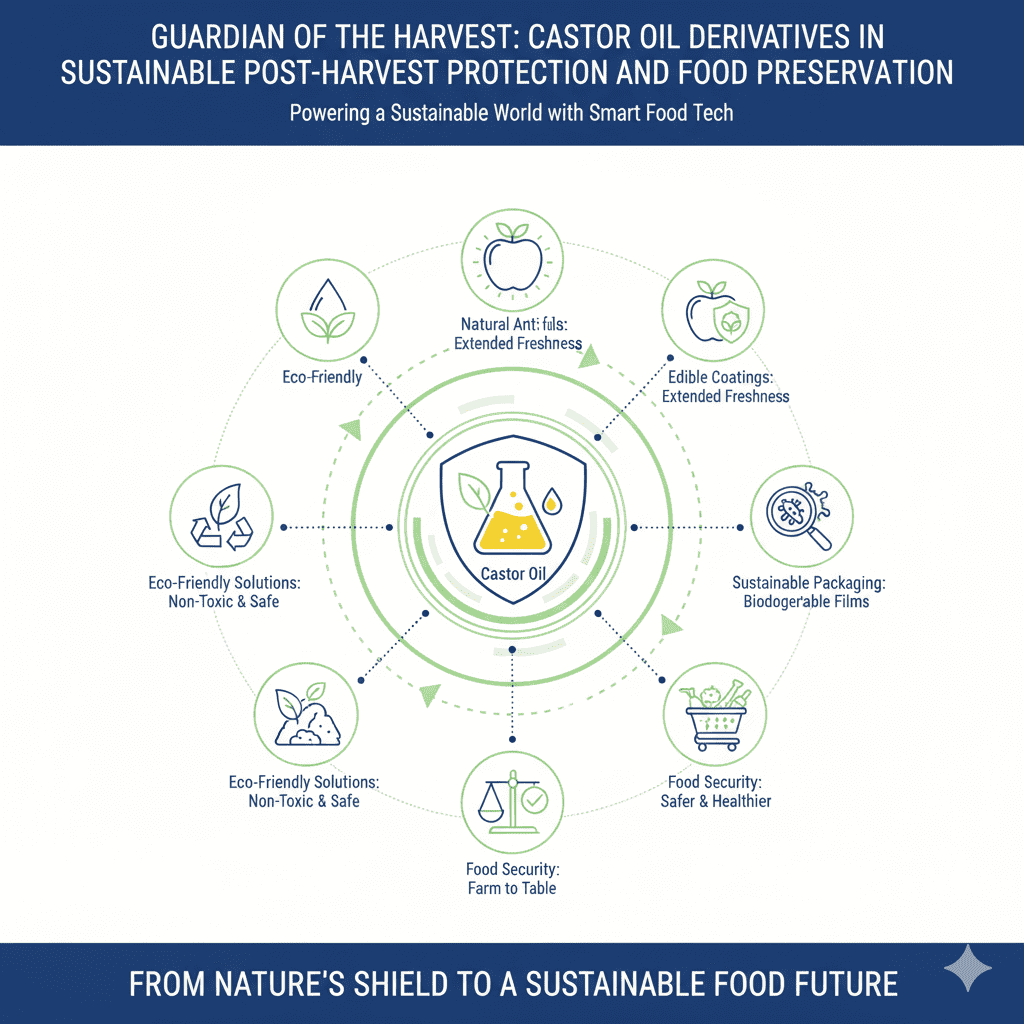
Guardian of the Harvest: Castor Oil Derivatives in Sustainable Post-Harvest Protection and Food Preservation

Summary: This article will uncover a critical, yet often unseen, application of castor oil derivatives: their innovative role in sustainable post-harvest protection and food preservation. A significant portion of food produced globally is lost post-harvest due to spoilage, pests, and inadequate storage, contributing to massive economic losses and environmental impact. Castor-based waxes, edible coatings, anti-fungal agents, and specialized packaging materials are being developed to extend the shelf life of fruits, vegetables, and other perishables. These bio-based solutions offer safer, non-toxic, and biodegradable alternatives to conventional synthetic preservatives and packaging, actively combating food waste, ensuring food security, and reducing the environmental footprint associated with food supply chains. Castor oil acts as a silent guardian, helping to bring more of the harvest efficiently and safely from farm to table.

Key Points:

  • The global problem of food waste and its environmental and economic consequences.
  • Castor-based edible coatings and waxes for fruits and vegetables, extending freshness and reducing spoilage.
  • Development of natural anti-fungal and anti-microbial agents from castor derivatives for post-harvest treatment.
  • Use in specialized bio-degradable or compostable packaging films that protect produce and reduce plastic waste.
  • Applications in modified atmosphere packaging components to control ripening and decay.
  • Advantages: non-toxic, food-grade compatibility, biodegradability, and effectiveness in extending shelf life.
  • Contribution to food security, reduced resource consumption (water, energy, land), and lower greenhouse gas emissions from waste.
  • Driving innovation in sustainable cold chains and supply logistics for fresh produce.

Beyond the Battery: Castor Oil Derivatives in Sustainable Energy Storage and Grid Solutions

Summary: This article will venture into a cutting-edge domain for castor oil derivatives: their innovative applications in advanced energy storage and grid solutions, vital for the transition to a renewable energy future. As the world moves towards intermittent renewable energy sources, efficient and sustainable energy storage becomes paramount. Castor-based materials are being explored for use as components in electrolytes, binders for battery electrodes, separators, and even as structural materials for battery casings or supercapacitors. Their unique properties, such as thermal stability, dielectric strength, and potential for sustainable synthesis, make them attractive alternatives to traditional, often environmentally intensive, materials. The article will highlight how these bio-based innovations contribute to safer, more efficient, and more sustainable energy storage technologies, supporting the stability of smart grids and accelerating the global shift towards a fully renewable energy ecosystem.

Key Points:

  • The critical need for sustainable and efficient energy storage to support renewable energy (solar, wind).
  • Castor-based polyols and esters as components in electrolytes for lithium-ion batteries or solid-state batteries, enhancing safety and performance.
  • Use as binders for active materials in battery electrodes, improving adhesion and cycle life.
  • Development of bio-based separators for batteries, offering improved thermal stability and puncture resistance.
  • Potential in dielectric materials for capacitors and supercapacitors, leveraging high dielectric constant and low loss.
  • Advantages: renewability, reduced reliance on critical minerals, potential for lower toxicity and improved biodegradability.
  • Contribution to the circular economy within energy storage, reducing waste and raw material extraction.
  • Driving innovation for safer, more powerful, and environmentally responsible energy storage solutions.

The Multifunctional Marvel: Castor Oil Derivatives in Polymer Additives and Processing Aids

Summary: This article will uncover the unsung hero role of castor oil derivatives as multifunctional additives and processing aids within the broader polymer industry. While not always forming the main structure of a plastic, these bio-based compounds are crucial for enhancing the performance, durability, and manufacturability of a vast array of polymeric materials. This includes their use as environmentally friendly plasticizers that improve flexibility and reduce brittleness, as internal and external lubricants that facilitate molding and extrusion, as heat and light stabilizers that extend product lifespan, and as anti-fogging or defoaming agents. The article will highlight how these castor-based additives effectively replace many petroleum-derived and potentially hazardous alternatives, significantly contributing to the sustainability profile of everything from PVC and polyurethanes to rubbers and composites, making plastics greener from the inside out.

Key Points:

  • The widespread use and environmental concerns of conventional polymer additives (e.g., phthalate plasticizers).
  • Castor-based plasticizers: offering flexibility, durability, and non-toxicity to various polymers (e.g., PVC, bioplastics).
  • Role as lubricants and mold release agents in polymer processing, improving efficiency and reducing energy.
  • Use as heat and light stabilizers, extending the service life of plastic products and reducing material degradation.
  • Application as anti-fogging agents in packaging films and defoamers in polymer production.
  • Advantages: renewability, biodegradability of some forms, lower toxicity profile, compliance with green product standards.
  • Contribution to enhancing the performance and longevity of plastic products while minimizing environmental impact.
  • Driving innovation in sustainable polymer formulation and processing, making the plastic industry more circular.