
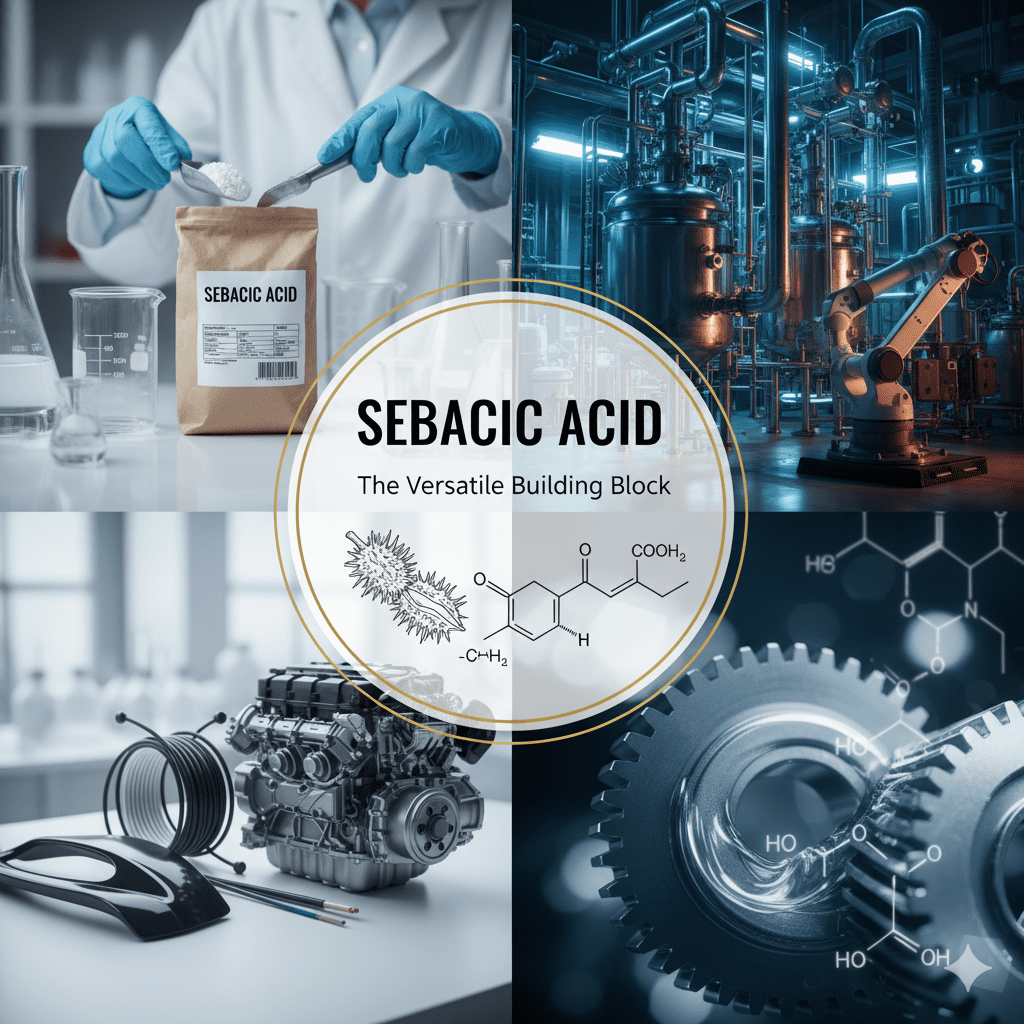
Introduction:
While many focus on the direct applications of castor oil, one of its most valuable and high-performance derivatives is Sebacic Acid. This dicarboxylic acid, a white crystalline powder, serves as a fundamental building block in the chemical industry, enabling the creation of advanced polymers, plasticizers, lubricants, and much more. Derived from renewable castor oil, sebacic acid offers a bio-based advantage in a world increasingly seeking sustainable solutions. What makes sebacic acid such a vital chemical intermediate, and where does its unique structure lead to groundbreaking innovations? Let’s explore its extensive capabilities.
What is Sebacic Acid?
Sebacic Acid (chemically, decanedioic acid) is a dicarboxylic acid with ten carbon atoms. It is primarily manufactured from castor oil through a complex process involving the cleavage of ricinoleic acid. The key characteristic of sebacic acid is its relatively long carbon chain coupled with two carboxylic acid groups at either end. This linear structure and the presence of two reactive functional groups make it exceptionally versatile for polymerization and other chemical syntheses. As a bio-based chemical, it’s a preferred choice over petroleum-derived alternatives in many applications.
Key Characteristics and Industrial Advantages:
- Long-Chain Dicarboxylic Acid: Its 10-carbon chain provides flexibility and excellent performance characteristics in polymers, especially in polyamides and polyesters, improving properties like flexibility, low-temperature performance, and dimensional stability.
- High Purity: Sebacic acid is typically produced to very high purity standards, which is essential for its use in demanding applications like nylons and aerospace lubricants.
- Bio-based Origin: Derived from renewable castor oil, it offers a sustainable and eco-friendly alternative to petrochemical-based dicarboxylic acids, aligning with green chemistry initiatives.
- Excellent Thermal Stability: Compounds and polymers derived from sebacic acid often exhibit good thermal stability.
- Low Toxicity: It is generally considered to have low toxicity, making it suitable for applications that interact with humans or the environment.
- Versatile Reactivity: The two carboxylic acid groups allow it to react with alcohols, amines, and other chemicals to form a wide range of esters, amides, and polymers.
Diverse Applications of Sebacic Acid:
The unique properties of sebacic acid make it a cornerstone ingredient in several high-performance industries:
- Polyamides (Nylons): It is a critical monomer in the production of specialty nylons (e.g., Nylon 6,10; Nylon 10,10), which are valued for their superior flexibility, impact resistance, and lower water absorption compared to other nylons. These are used in engineering plastics, textiles, and automotive parts.
- Plasticizers: Sebacic acid esters (e.g., Dibutyl Sebacate, Dioctyl Sebacate) are high-performance plasticizers, particularly for PVC, imparting excellent low-temperature flexibility, electrical properties, and resistance to extraction. They are vital in wire and cable insulation and automotive components.
- Lubricants and Greases: It is used in the synthesis of high-performance synthetic lubricants and aviation turbine oils, offering excellent thermal stability, oxidative resistance, and viscosity properties across wide temperature ranges.
- Polyesters and Alkyd Resins: Incorporated into polyesters and alkyd resins to improve flexibility, durability, and resistance.
- Corrosion Inhibitors: Used in certain formulations for its anti-corrosive properties.
- Adhesives and Sealants: Enhances flexibility and performance in specific adhesive systems.
- Cosmetics and Perfumes: Smaller quantities can be found as an ingredient in some cosmetic formulations.
Why Choose Our Sebacic Acid?
We provide high-purity Sebacic Acid, meticulously manufactured from renewable castor oil to meet the exacting demands of various industries. Our commitment to quality ensures a consistent and reliable supply of this vital chemical building block, empowering your innovations with sustainability and superior performance.
Conclusion:
Sebacic Acid is a powerful example of how a natural resource can be transformed into a high-value chemical essential for modern technology. Its unique dicarboxylic structure, combined with its bio-based origin, positions it as a preferred ingredient for creating advanced polyamides, specialty plasticizers, and high-performance lubricants. As industries continue to seek sustainable yet superior solutions, sebacic acid will undoubtedly remain a key player in chemical innovation.
Relevant Keywords for Sebacic Acid:
Primary Keywords:
- Sebacic Acid
- Decanedioic Acid
- Castor oil derivative
- Sebacic Acid supplier
- Bio-based Sebacic Acid
Secondary Keywords:
- Dicarboxylic acid
- Nylon 6,10 monomer
- Plasticizer sebacate
- Synthetic lubricant raw material
- Polymer building block
- Bio-plasticizer
- Castor chemical
- Renewable chemical
- High performance polymer
- Engineering plastics ingredient
- Corrosion inhibitor sebacic acid
Long-Tail Keywords/Phrases:
- Uses of Sebacic Acid in polyamide synthesis
- Benefits of sebacic acid for synthetic lubricants
- High purity sebacic acid for plasticizers
- Sebacic acid applications in automotive industry
- Sustainable dicarboxylic acid from castor oil
- Where to buy sebacic acid
- Chemical properties and uses of decanedioic acid
- Sebacic acid for low temperature flexibility in polymers