
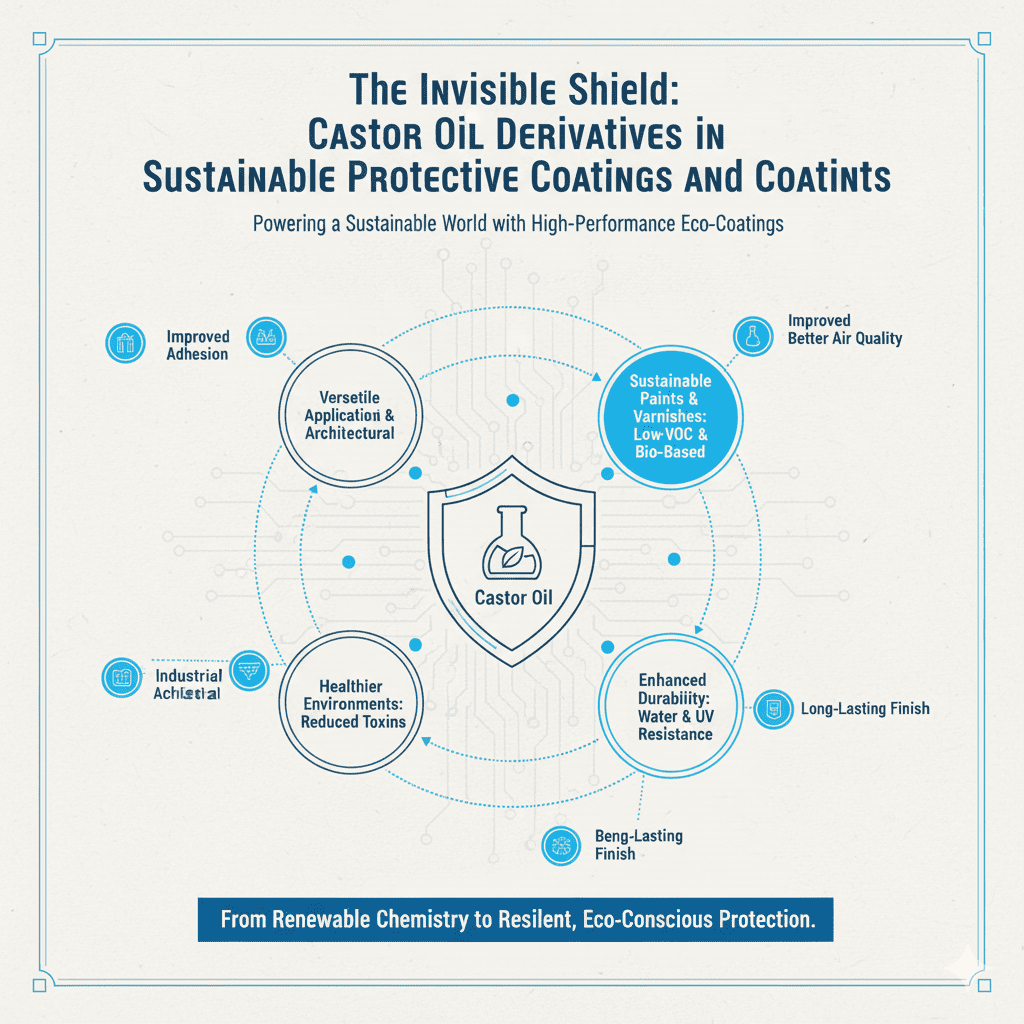
Summary: This article will explore the often-unseen but crucial role of castor oil derivatives in revolutionizing the paints and coatings industry, moving it towards a more sustainable future. Traditional paints often rely on high levels of volatile organic compounds (VOCs) and petroleum-derived resins, posing environmental and health concerns. Castor-based polyols, alkyd resins, and specialized fatty acid derivatives are being expertly formulated into high-performance, low-VOC, and bio-based paints, varnishes, and protective coatings. These innovations offer superior properties such as enhanced durability, flexibility, water resistance, and UV stability, all while significantly reducing the carbon footprint and improving air quality. The article will highlight how castor oil provides an “invisible shield” that not only protects surfaces but also safeguards the planet, meeting the demand for greener, healthier, and long-lasting coating solutions across industries.
Key Points:
- Environmental and health issues associated with traditional paints and coatings (VOCs, hazardous chemicals).
- Castor polyols as key components in bio-based polyurethanes for durable and flexible coatings.
- Castor-modified alkyd resins for paints, offering improved drying times and hardness.
- Role as natural plasticizers, dispersants, and wetting agents in paint formulations, enhancing performance and stability.
- Applications across architectural paints, industrial coatings (e.g., automotive, marine, wood), and protective finishes.
- Advantages: low VOC content, reduced odor, good film-forming properties, excellent adhesion, and weather resistance.
- Contribution to healthier indoor environments and reduced outdoor air pollution.
- Driving innovation towards a sustainable coating industry that doesn’t compromise on performance or aesthetics.
