
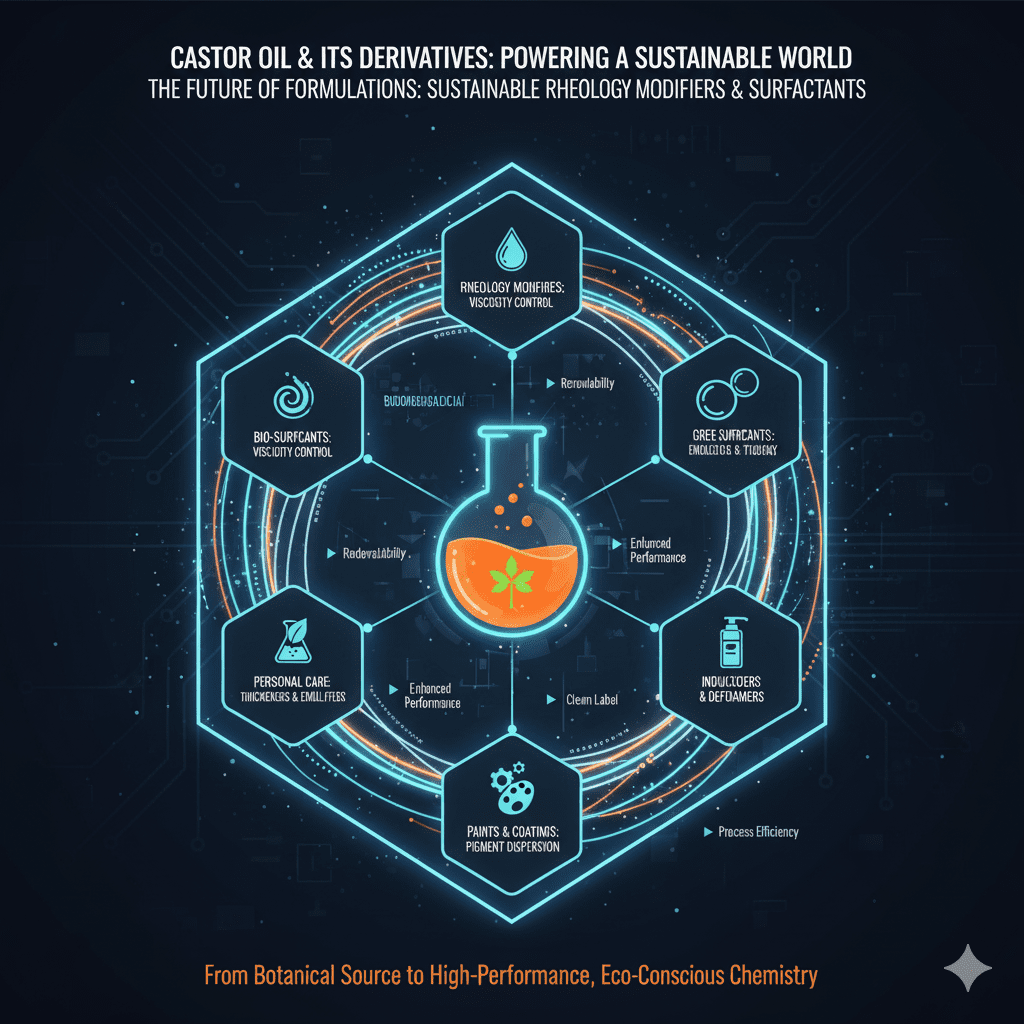
Summary: This article will delve into the profound and pervasive impact of castor oil derivatives as fundamental building blocks in modern formulations: serving as highly effective and sustainable rheology modifiers and surfactants. These two classes of compounds are critical for controlling the flow, texture, stability, and mixing properties of virtually every liquid or semi-solid product, from paints and cosmetics to pharmaceuticals and industrial fluids. Castor-based waxes, polyols, and ethoxylates offer bio-based alternatives that can thicken, emulsify, disperse, and stabilize formulations, often outperforming synthetic counterparts while significantly reducing reliance on petrochemicals. The article will highlight how these versatile derivatives enable manufacturers to create products with desirable sensory profiles, enhanced performance, and extended shelf-life, all while adhering to rigorous sustainability standards and meeting consumer demand for greener, cleaner labels across a vast spectrum of consumer and industrial goods.
Key Points:
- The fundamental importance of rheology (flow properties) and surface activity (surfactants) in product formulation.
- Castor-based waxes and hydrogenated castor oil as bio-based rheology modifiers for thickening, gelling, and controlling viscosity in paints, lubricants, and personal care.
- Castor ethoxylates and other castor-derived esters as effective bio-surfactants and emulsifiers, enabling stable mixtures of oil and water.
- Applications in a vast range of products: detergents, cosmetics, pharmaceuticals, agrochemicals, industrial coatings, and drilling fluids.
- Advantages: renewability, biodegradability, often lower irritation profile, and performance comparable to or superior to synthetics.
- Contribution to reducing VOCs, replacing hazardous chemicals, and improving the overall eco-profile of countless formulations.
- Driving innovation in “green” product development and supporting cleaner manufacturing processes.