
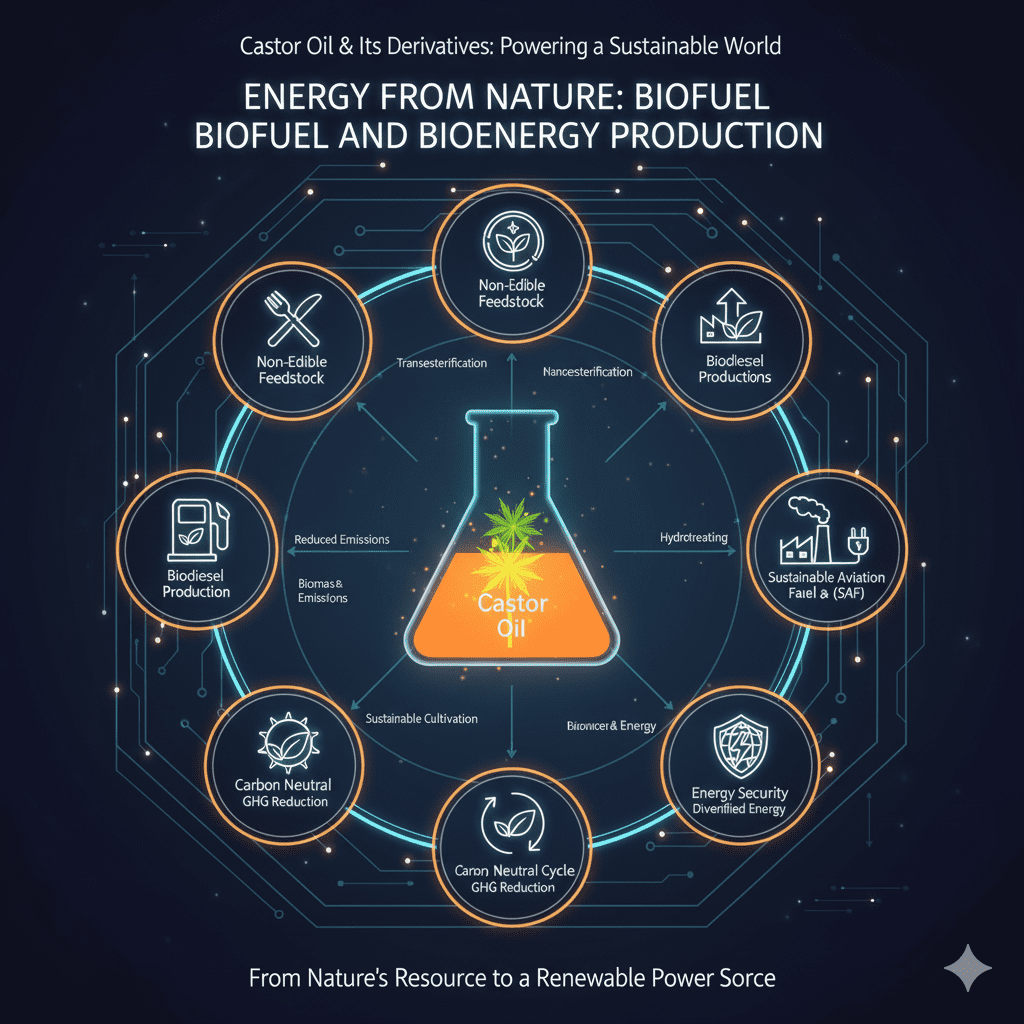
Summary: This article will illuminate castor oil’s significant and evolving role in the quest for sustainable energy, positioning it as a key renewable feedstock for biofuel and bioenergy production. Amidst global efforts to decarbonize energy systems, castor oil’s non-edible nature and high oil yield make it an attractive source for generating biodiesel, advanced biofuels, and even components for sustainable aviation fuel (SAF). Its unique fatty acid profile allows for efficient conversion processes, contributing to lower greenhouse gas emissions compared to fossil fuels. The article will delve into the technologies and processes that transform castor oil into viable energy sources, highlighting its potential to power transportation, generate electricity, and contribute to a more secure and environmentally responsible energy future.
Key Points:
- The global challenge of energy transition and the need for renewable liquid fuels.
- Castor oil as a non-edible feedstock, avoiding competition with food crops (unlike some other biofuels).
- Production of biodiesel from castor oil via transesterification: properties and benefits (lower emissions).
- Research and development into advanced biofuels (e.g., bio-jet fuel) derived from castor oil.
- Potential for using castor biomass or residues for bio-gas or direct combustion for heat and power.
- Advantages: high energy content, reduced particulate emissions, carbon neutrality (if sustainably farmed).
- Contribution to energy security and diversification of energy sources.
- Addressing the challenges of scaling bioenergy production and ensuring sustainability throughout the lifecycle.
