
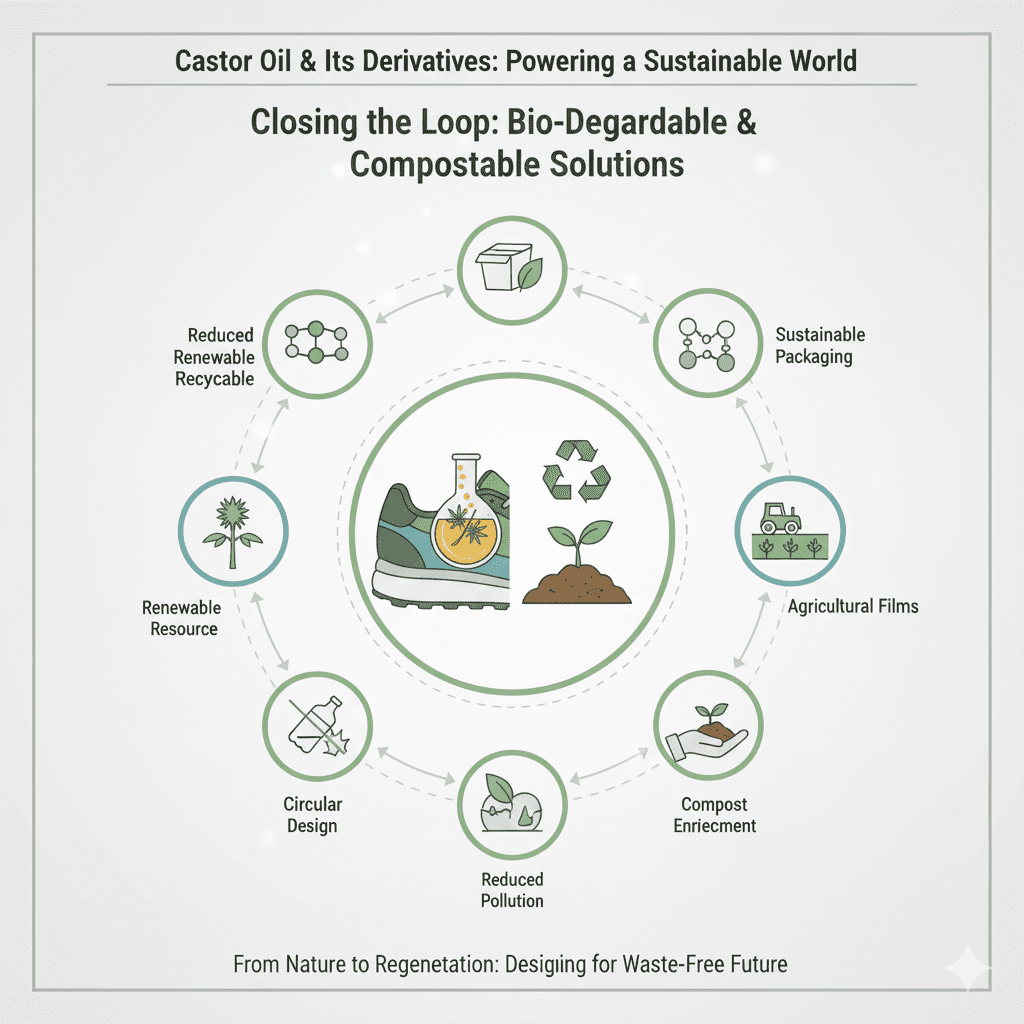
Summary: This article will center on a critical frontier in sustainability: the development of truly biodegradable and compostable materials, with castor oil derivatives playing a pivotal role. As global waste crises escalate, there is an urgent need for materials that can safely return to nature without leaving lasting pollution. Castor-based polyols and specialty polymers are being engineered to create bioplastics, films, and coatings that are designed to break down under specific environmental conditions (e.g., industrial composting) or even naturally in various ecosystems. The article will highlight how these innovative, bio-based solutions offer viable alternatives for single-use plastics, packaging, and agricultural films, fundamentally addressing the end-of-life challenge and helping to “close the loop” in a circular economy by transforming waste back into organic matter, enriching soil, and supporting ecological balance.
Key Points:
- The global problem of persistent plastic pollution and the need for biodegradable alternatives.
- Castor-based polyols and diacids as building blocks for biopolymers with controlled biodegradability and compostability.
- Applications in biodegradable packaging films, single-use consumer goods, and agricultural mulching films.
- Explanation of how these materials break down into natural components (CO2, water, biomass) under composting conditions.
- Distinguishing between biodegradable, compostable, and oxo-degradable plastics.
- Advantages: reduced landfill burden, mitigation of microplastic pollution, enrichment of soil through composting.
- Challenges and standards for certification of biodegradability and compostability.
- Driving the shift towards a zero-waste future by designing materials for circularity from inception.
