
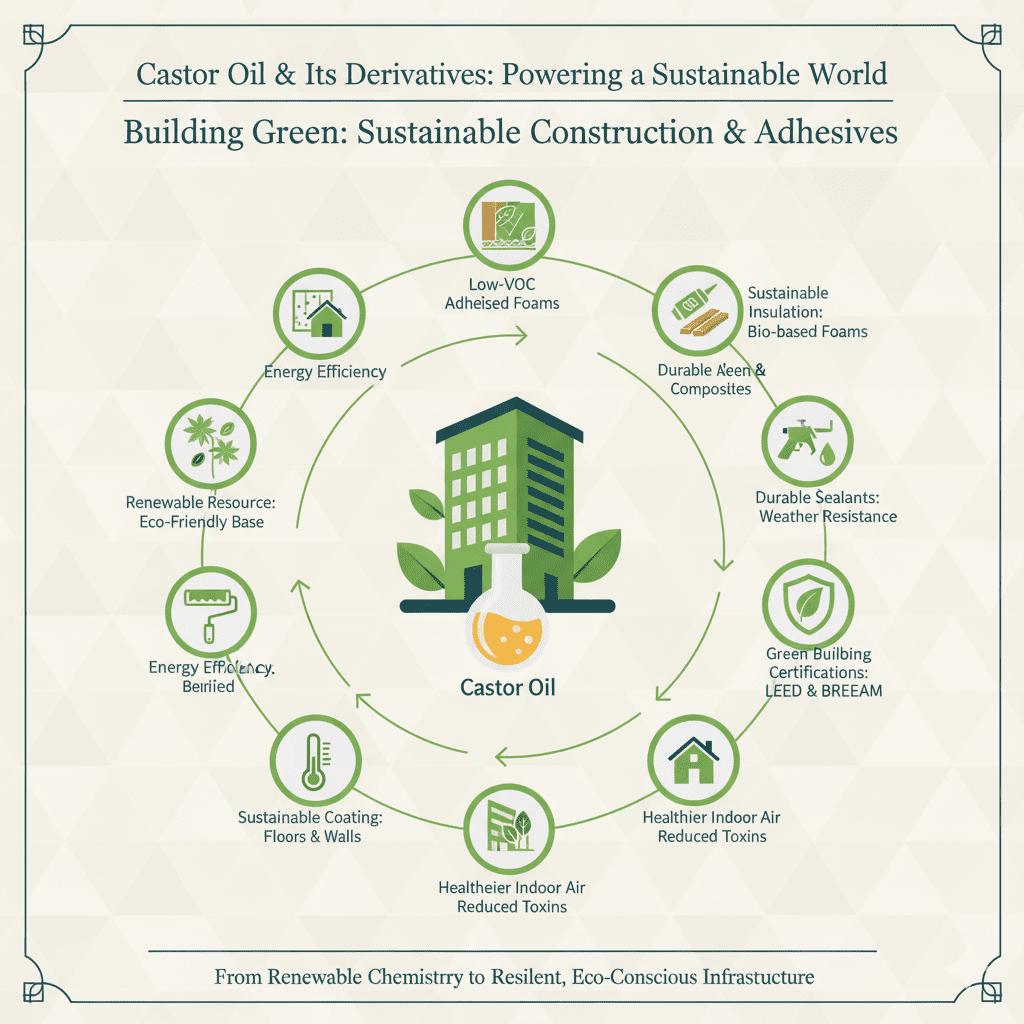
Summary: This article will highlight the growing importance of castor oil derivatives in the construction sector, driving the development of more sustainable building materials, adhesives, sealants, and insulation. As the industry strives for reduced environmental impact and healthier indoor air quality, castor-based polyols are replacing petrochemicals in polyurethane foams for insulation, offering better thermal efficiency and reduced off-gassing. Furthermore, castor derivatives are being formulated into low-VOC (Volatile Organic Compound) adhesives, binders for wood composites, and durable sealants, significantly improving the eco-profile of construction projects. The article will emphasize how these bio-based solutions contribute to green building certifications, enhance worker safety, and create long-lasting, environmentally responsible infrastructure for the future.
Key Points:
- The significant environmental footprint of the traditional construction industry.
- Castor-based polyols for rigid and flexible polyurethane foams used in insulation, improving energy efficiency in buildings.
- Development of low-VOC and formaldehyde-free adhesives and binders for wood products (plywood, particleboard), enhancing indoor air quality.
- Use in sustainable sealants and caulks, offering durability and weather resistance with reduced environmental impact.
- Castor derivatives as components in sustainable coatings for floors, walls, and roofs, providing protection and aesthetics.
- Contribution to green building standards and certifications (e.g., LEED, BREEAM).
- Advantages: renewability, reduced toxicity during application and throughout product lifespan, improved safety for construction workers and occupants.
- Driving innovation towards a healthier, more sustainable built environment.
