
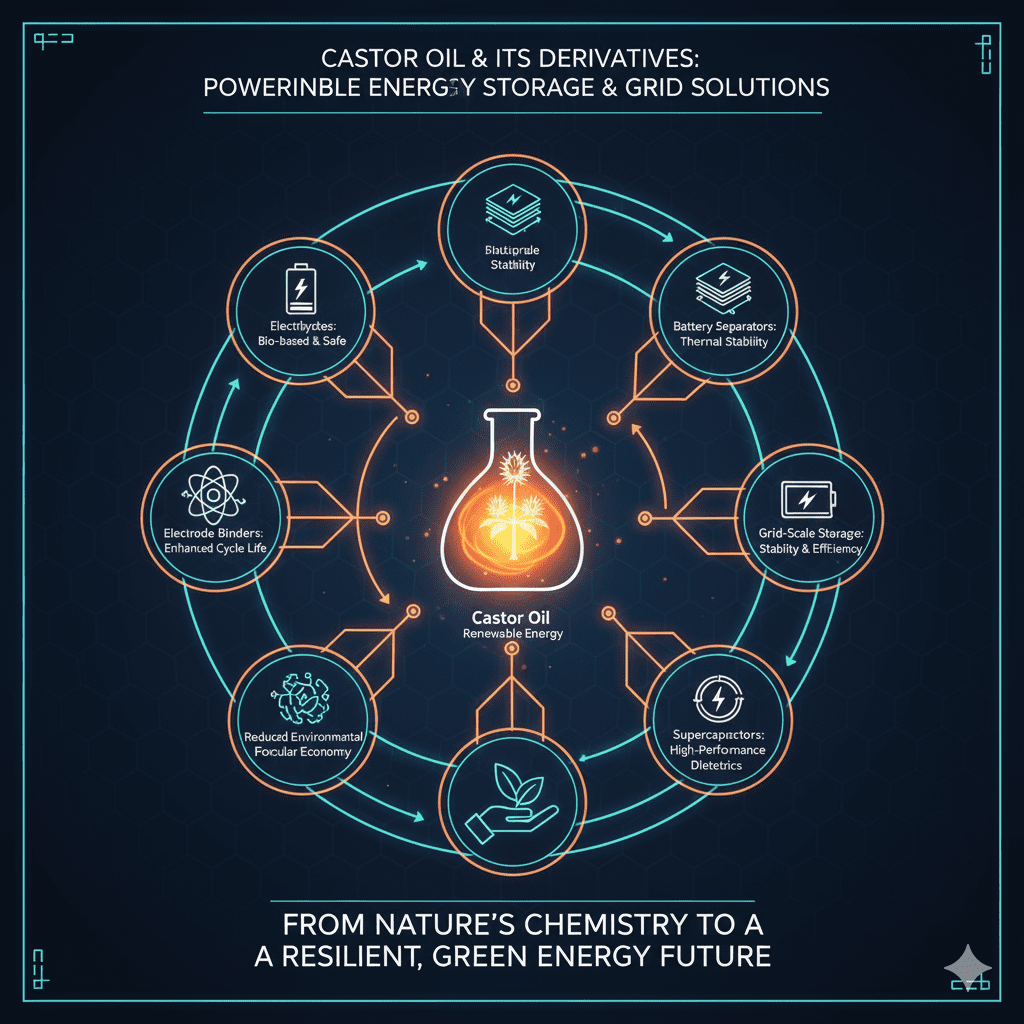
Summary: This article will venture into a cutting-edge domain for castor oil derivatives: their innovative applications in advanced energy storage and grid solutions, vital for the transition to a renewable energy future. As the world moves towards intermittent renewable energy sources, efficient and sustainable energy storage becomes paramount. Castor-based materials are being explored for use as components in electrolytes, binders for battery electrodes, separators, and even as structural materials for battery casings or supercapacitors. Their unique properties, such as thermal stability, dielectric strength, and potential for sustainable synthesis, make them attractive alternatives to traditional, often environmentally intensive, materials. The article will highlight how these bio-based innovations contribute to safer, more efficient, and more sustainable energy storage technologies, supporting the stability of smart grids and accelerating the global shift towards a fully renewable energy ecosystem.
Key Points:
- The critical need for sustainable and efficient energy storage to support renewable energy (solar, wind).
- Castor-based polyols and esters as components in electrolytes for lithium-ion batteries or solid-state batteries, enhancing safety and performance.
- Use as binders for active materials in battery electrodes, improving adhesion and cycle life.
- Development of bio-based separators for batteries, offering improved thermal stability and puncture resistance.
- Potential in dielectric materials for capacitors and supercapacitors, leveraging high dielectric constant and low loss.
- Advantages: renewability, reduced reliance on critical minerals, potential for lower toxicity and improved biodegradability.
- Contribution to the circular economy within energy storage, reducing waste and raw material extraction.
- Driving innovation for safer, more powerful, and environmentally responsible energy storage solutions.