

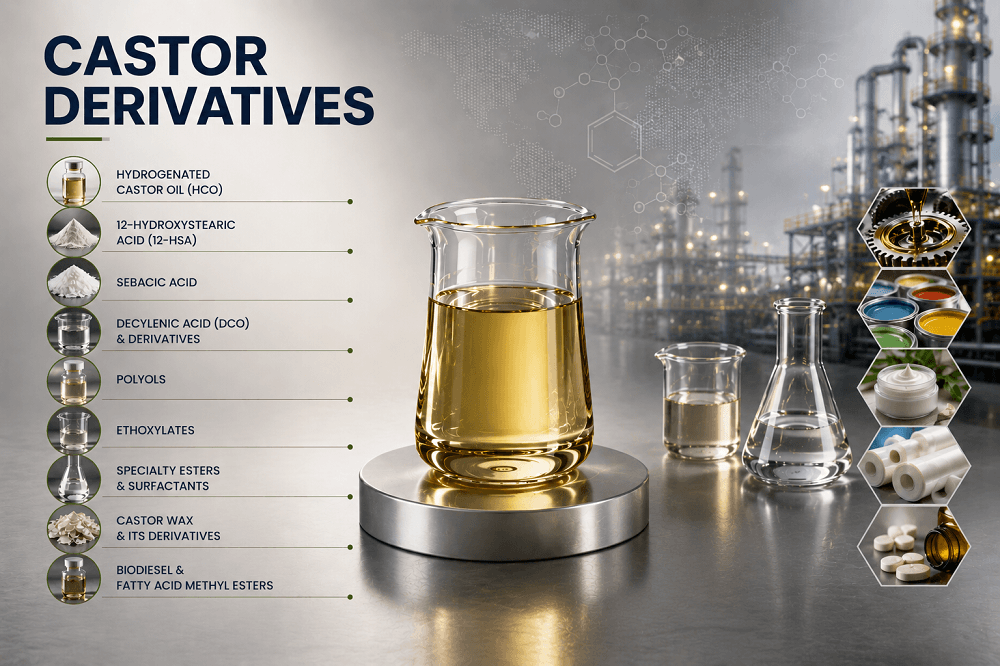
Castor derivatives occupy a unique position in industrial chemistry. Unlike conventional fatty acid derivatives, castor-based materials possess a naturally occurring hydroxyl group that enables chemical versatility and functional tuning. This makes castor derivatives essential in applications where performance consistency and formulation stability are critical.
Understanding Castor Derivatives at a Molecular Level
The defining feature of castor derivatives is the hydroxyl functionality present in ricinoleic acid. This structure allows:
- Hydrogen bonding
- Controlled reactivity
- Improved lubricity
- Enhanced thermal behavior
When chemically modified, these properties can be amplified or redirected for specific industrial needs.
How Chemical Modification Changes Performance
Each derivative is engineered through a specific transformation:
- Hydrogenation increases hardness, melting point, and oxidative stability
- Dehydration enhances drying and film-forming behavior
- Hydrolysis isolates functional fatty acids
- Esterification improves solubility and formulation flexibility
These changes are not cosmetic—they directly influence real-world application results.
Functional Role of Major Castor Derivatives
Different derivatives exist because industries demand different behaviors, not because of product variety.
Examples:
- Hard wax-like derivatives for grease structure
- Acid derivatives for chemical intermediates
- Dehydrated derivatives for coating performance
- Ester derivatives for formulation compatibility
Understanding this functional logic helps buyers select the right derivative, not just a familiar name.
Why Castor Derivatives Outperform Many Alternatives
From an application standpoint, castor derivatives offer:
- Renewable, plant-based origin
- Strong performance at extreme temperatures
- Compatibility with complex chemical systems
- Predictable behavior in long-term use
This combination explains their continued relevance despite evolving synthetic alternatives.
Application-Driven Selection Matters
One of the most common sourcing mistakes is selecting derivatives based on availability instead of functional requirement. Proper selection depends on:
- End-use temperature range
- Mechanical stress exposure
- Chemical environment
- Regulatory expectations
Education-driven sourcing reduces formulation failures and long-term costs.
India’s Knowledge Advantage in Castor Derivatives
India’s leadership in castor derivatives is not only agricultural—it is technical. Decades of processing experience, formulation feedback, and export exposure have created a deep knowledge base that supports continuous improvement and innovation.
Manufacturers such as Nova Industries contribute by aligning chemical understanding with controlled manufacturing practices.
Closing Perspective
Castor derivatives are not commodity chemicals—they are engineered functional materials. Their true value emerges when chemistry knowledge, manufacturing discipline, and application understanding work together.
For industries seeking consistency, sustainability, and performance, castor derivatives remain a strategically important material class.