
Castor Oil Derivatives
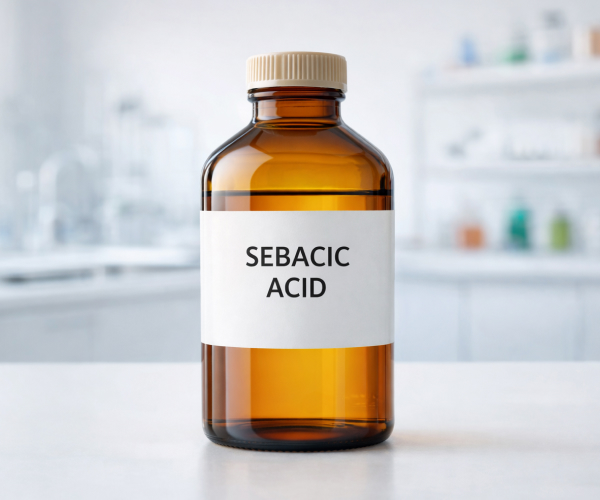
Sebacic Acid
- Brand: Nova Industries
- Category: Castor Oil Derivatives
- Sub-Category: Dicarboxylic Acids / Bio-Based Acids
- Compliance Class: Industrial / Specialty Chemical
- Chemical Type: C10 dicarboxylic acid derived from castor oil (ricinoleic acid alkali fusion)
- Grade: Technical / high-purity grades
- Physical Form: White crystalline solid
Product Overview
Sebacic Acid is a bio-based dicarboxylic acid derived from castor oil and valued globally for its chemical stability, flexibility contribution, and renewable origin. As a C10 diacid, it occupies a critical position in polymer chemistry, enabling the production of materials that combine strength with flexibility and resistance to moisture and chemicals.
At Nova Industries, Sebacic Acid is produced through a controlled cleavage and purification process starting from castor oil derivatives, ensuring consistent purity, controlled particle form, and reliable performance across batches. Tight control over crystallization and finishing allows the product to meet the demanding requirements of polymer, lubricant, and specialty chemical manufacturers.
Unlike petrochemical-based diacids, castor-derived Sebacic Acid offers a renewable, non-toxic, and environmentally responsible alternative without compromising technical performance. Buyers choose this material when they need predictable reactivity, stable supply, and compatibility with high-performance formulations across diverse industrial sectors.
Technical Specifications:
| Parameter | Specification / Value |
|---|---|
| Appearance | Colorless to pale yellow liquid |
| Odour | Faint, characteristic |
| Melting Point | 131.0°C – 134.5°C |
| Acid Value | Min 550 mg KOH/g |
| Purity | Min 99.5% (High Purity) |
| Moisture Content | Max 0.20% |
| Ash Content | Max 0.03% |
| Colour (APHA, solution) | Max 15 (in 10% Alcohol) |
| Solubility | Slightly soluble in water; soluble in alcohols, ethers |
What the Product Does & Buyer Problems It Solves
What it does
- Acts as a key monomer and intermediate
- Improves flexibility, toughness, and hydrolytic stability
- Enables bio-based formulation pathways
Problems it solves
- Reduces reliance on petroleum-derived diacids
- Improves polymer flexibility and low-temperature performance
- Enhances durability and chemical resistance
- Supports sustainability targets without performance loss
Key Properties & Performance Characteristics
Physical & Chemical Characteristics
- Appearance: White crystalline flakes / powder
- Odor: Odorless
- Solubility: Slightly soluble in water; soluble in alcohols and organic solvents
- Molecular structure: Linear C10 dicarboxylic acid
Functional Performance
- Excellent thermal stability during processing
- Predictable reactivity in condensation reactions
- Enhances flexibility and toughness in polymers
- Good compatibility with alcohols, amines, and esters
Stability, Shelf Life & Storage
- Shelf Life: Up to 24 months under proper storage
- Storage Conditions:
- Store in a cool, dry, well-ventilated area
- Protect from moisture and contamination
- Keep containers tightly sealed
- Stability: Chemically stable under normal industrial storage conditions
Manufacturing & Quality Control
Sebacic Acid at Nova Industries is manufactured through a multi-stage process involving controlled conversion of castor oil derivatives, purification, crystallization, and grading.
Quality assurance includes
- In-house testing for purity, melting point, and acidity
- Batch-wise traceability and documentation
- Particle size and appearance control
- Pre-dispatch quality verification
This ensures uniform quality and dependable long-term supply.
Typical Buyer Workflow:
Sample → Lab synthesis / formulation → Performance validation → Bulk supply agreement
Packaging & Supply Information
- Standard Packaging:
- 25 kg HDPE bags / fiber drums
- Bulk Supply: Palletized container loads
- Minimum Order Quantity (MOQ): Based on packaging format
- Lead Time: 7–15 working days
- Custom Packaging: Available on request
- Sample Availability: Yes, for evaluation and trials
Quality, Compliance & Documentation
- Technical Data Sheet (TDS): Available
- Safety Data Sheet (SDS): Available
- Certificate of Analysis (COA): Provided per batch
- Compliance & Certifications:
- ISO-based quality management systems
- REACH documentation support
- Suitable for global industrial, cosmetic & pharma use (as per grade)
Global Export Readiness
- Export-grade moisture-protected packaging
- Optimized container loading and palletization
- Complete export documentation (COA, TDS, SDS, invoices, packing list)
- Consistent batch quality for long-term international buyers
- Importer documentation and customs assistance
We're Here to Help
Drop Us a message Today
Share your requirements and our team will get back to you within 24 hours.
why Us
Why Choose Nova Industries?
A few reasons why we insist you to choose Nova Industries are:
-

Fresh & Pure Products
Sourced and processed with care to retain maximum purity and effectiveness.
-

Export-Ready Standards
Fully compliant with international quality norms, ensuring smooth global shipments.
-

Long Shelf Life
Advanced refining and packaging methods keep our products stable and effective for extended periods.
-

Global Supply Capability
Robust infrastructure and logistics support to serve clients worldwide with on-time delivery.
Your Global Partner for Castor Oil Solutions
Get in touch with us for reliable supply, competitive pricing, and export-ready castor oil and derivatives.
Industry Applications & Use Cases
-
Polyamides & Engineering Plastics
Used in the production of nylon 6,10 and other polyamides to enhance flexibility, chemical resistance, and moisture stability.

-
Plasticizers & Esters
Acts as a raw material for sebacate esters used in flexible plastics and specialty applications.

-
Lubricants & Functional Fluids
Used in ester-based lubricants where thermal stability and low-temperature performance are required.

-
Cosmetics & Personal Care
Applied in formulations where bio-based acids and derivatives are preferred.

-
Pharmaceuticals
Used as an intermediate in drug formulations and excipients (as per specification).

FAQ’s
Buyer Guidance & FAQs
Yes, it is derived from castor oil, making it a renewable raw material.
Yes, it is widely used in polyamide and engineering plastic applications.
Yes, with stable specifications and batch consistency.
Yes, samples are available on request.
Testimonials
valuable words from our client
We have been sourcing Hydrogenated Castor Oil and 12HSA from Nova Industries for over three years. Their product consistency and batch quality are highly reliable, which is critical for our manufacturing process. Deliveries are always on time, and their team is very responsive.
Nova Industries stands out for their professionalism and technical understanding. The quality of their castor oil derivatives meets international standards, and their documentation and export support make global sourcing seamless for us.
What we value most is Nova’s consistency and transparency. From inquiry to shipment, the process is smooth and well-managed. Their castor oil grades perform exactly as specified, helping us maintain product quality across our production lines.