
Castor Oil Derivatives
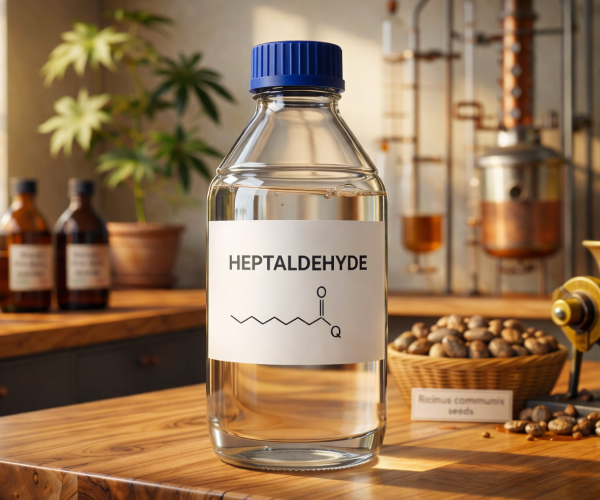
Heptaldehyde
- Brand: Nova Industries
- Category: Castor Oil Derivatives
- Sub-Category: Aldehyde Intermediates / Specialty Chemicals
- Compliance Class: Industrial / Fragrance / Pharmaceutical Intermediate
- Chemical Type: C7 saturated aliphatic aldehyde – co-product of ricinoleic acid pyrolysis alongside undecylenic acid
- Grade: Technical / specialty grades
- Physical Form: Clear, colourless to pale yellow liquid
Product Overview
Heptaldehyde, also known as n-Heptanal, n-Heptaldehyde, Heptanaldehyde, Aldehyde C-7, or Enanthaldehyde (CAS No. 111-71-7), is a seven-carbon linear chain saturated aldehyde obtained as a co-product of the pyrolysis (cracking) of ricinoleic acid derived from castor oil. It is a colourless to pale yellow oily liquid with a distinctive strong fruity, fatty, and penetrating odour. As a 100% bio-based compound of vegetable origin derived from castor oil, heptaldehyde occupies an important position in the fragrance, flavour, rubber, and fine chemical industries.
Nova Industries manufactures heptaldehyde at our integrated Gujarat facility as part of our castor oil derivative processing operations. Our product conforms to commercially accepted purity standards (typically 95–97%+ GC purity) and is supplied to buyers in the perfumery, fragrance synthesis, rubber chemicals, and pharmaceutical intermediate sectors globally. The compound’s reactivity and distinctive aroma profile make it a versatile building block for constructing complex fragrance molecules and specialty chemicals.
Technical Specifications:
| Parameter | Specification / Value |
|---|---|
| Appearance | Colorless to Pale Yellow Liquid |
| Odour | Pungent, fruity / fatty aldehyde odour |
| Purity (by GC) | Min 97.0% |
| Specific Gravity (25°C) | 0.815 – 0.825 g/cm³ |
| Boiling Point | 153 – 155°C |
| Melting Point | -43°C (approx.) |
| Refractive Index (20°C) | 1.412 – 1.416 |
| Moisture Content | Max 0.20% |
| Acid Value | Max 3.0 mg KOH/g |
| Colour (APHA) | Max 30 |
| Flash Point | 39°C (approx.) |
| Solubility | Slightly soluble in water; miscible with ethanol, ether, most organic solvents |
What Heptaldehyde Does & Buyer Problems It Solves
What It Does:
- Acts as a key fragrance and flavour building block – heptaldehyde is a direct ingredient in perfumery (contributing fatty, green, and fresh notes) and a precursor to important aroma chemicals including jasmine aldehyde (alpha-amyl cinnamaldehyde), coconut aldehyde, and delta-dodecalactone used in fine fragrances.
- Functions as an intermediate for chemical synthesis – through oxidation to heptanoic acid, reduction to heptyl alcohol (1-heptanol), or condensation reactions, heptaldehyde generates a family of commercially important derivatives used across pharmaceuticals, lubricants, flavours, and industrial chemicals.
- Serves as a reactive component in rubber chemicals – heptaldehyde and its derivatives are used in the preparation of vulcanization accelerators for rubber processing, and the compound itself acts as a solvent and processing aid in rubber and plastics manufacturing.
Buyer Problems It Solves:
- If you need a bio-based, non-petroleum-derived C7 aldehyde for fragrance or aroma chemical synthesis – heptaldehyde from castor oil is 100% vegetable-origin, aligning with bio-based sourcing requirements in the fragrance and flavour industry.
- If your fragrance formulation requires a natural-origin aldehyde building block to replace synthetic C7 aldehydes – our product carries a bio-based origin claim and can be verified as derived from castor oil.
- If sourcing heptaldehyde with consistent purity, predictable lot-to-lot quality, and reliable export capability is a challenge – Nova Industries’ established castor derivative manufacturing gives you a dependable single-source supplier.
- If you require FEMA GRAS status recognition for flavour applications – heptanal is recognised as a flavouring agent (FEMA No. 2541/2542) and is used in food flavour formulations in trace quantities.
Key Properties & Performance Characteristics
- Chemical Name: n-Heptanal / Heptaldehyde / 1-Heptanal
- CAS No.: 111-71-7
- Molecular Formula: C₇H₁₄O
- Appearance: Colourless to pale yellow oily liquid
- Odour: Strong, penetrating fruity-fatty odour; harsh with an unpleasant fatty note at high concentrations
- Purity: ≥ 95% (GC) – 97%+ grades available
- Flash Point: ~57°C (flammable – handle with care)
- Boiling Point: 153°C
- Specific Gravity (25°C): ~0.818
- Water Solubility: Practically insoluble in water; miscible with alcohol and organic solvents
- Stability: Can undergo self-condensation reactions; stabilized grades available for storage
Stability, Shelf Life & Storage
- Shelf Life: 12 months from date of manufacture when stored correctly
- Storage Temperature: Store below 25°C in cool, dark, well-ventilated area
- Fire Risk: Heptaldehyde is flammable (flash point ~57°C) – keep away from open flames, sparks, and heat sources
- Polymerization / Condensation: Can self-condense or polymerize under acidic conditions or in the presence of traces of water – store in clean, dry, tightly sealed containers under nitrogen headspace if needed
- Avoid contact with: Strong oxidizing agents, acids, bases, and direct heat
- Packaging: Supplied in sealed 200 kg MS drums or customized IBC containers with inert atmosphere protection
Manufacturing & Quality Control
Heptaldehyde at Nova Industries is produced through the pyrolysis (thermal cracking) of ricinoleic acid derived from castor oil:
- Ricinoleic Acid Source: Derived from hydrolysis of high-quality castor oil
- Cracking Process: Controlled thermal cracking of ricinoleic acid yields heptaldehyde and undecylenic acid as co-products
- Distillation & Purification: Product isolated and purified by fractional distillation to achieve target GC purity (≥95%)
- Quality Testing: Purity (GC), Appearance, Specific Gravity, Refractive Index, and odour character tested per batch
- Documentation: Batch CoA, MSDS, and export documents provided with every consignment
We're Here to Help
Drop Us a message Today
Share your requirements and our team will get back to you within 24 hours.
why Us
Why Choose Nova Industries?
A few reasons why we insist you to choose Nova Industries are:
-

Fresh & Pure Products
Sourced and processed with care to retain maximum purity and effectiveness.
-

Export-Ready Standards
Fully compliant with international quality norms, ensuring smooth global shipments.
-

Long Shelf Life
Advanced refining and packaging methods keep our products stable and effective for extended periods.
-

Global Supply Capability
Robust infrastructure and logistics support to serve clients worldwide with on-time delivery.
Your Global Partner for Castor Oil Solutions
Get in touch with us for reliable supply, competitive pricing, and export-ready castor oil and derivatives.
Industry Applications & Use Cases
-
Fragrance & Perfumery Industry
Heptaldehyde is a valued building block in fine fragrance synthesis. It contributes green, fatty, and fresh aldehydic notes and is used as a precursor for creating aroma chemicals such as alpha-amyl cinnamaldehyde (jasmine aldehyde), coconut aldehyde, and linear and cyclic acetals used in premium perfumes and personal care fragrances.

-
Flavour & Food Flavouring Industry
Recognised as a food flavouring agent (FEMA No. 2541/2542), heptanal occurs naturally in allspice, orange peel, and various essential oils. It is used in trace quantities in food flavour formulations to reproduce or enhance fatty, citrus, and fresh-herbal notes in processed food and beverages.

-
Rubber Chemicals & Vulcanization
Heptaldehyde and its derivatives are used in the rubber processing industry for the preparation of vulcanization accelerators. The compound also serves as a processing solvent and reactive modifier in certain rubber and plastics formulation systems.

-
Pharmaceutical Intermediates
Used as a chemical intermediate in the synthesis of pharmaceutical compounds. Heptanal can be converted to heptanoic acid (by oxidation), 1-heptanol (by reduction), or ethyl heptanoate - all of which serve as intermediates in pharmaceutical and specialty chemical synthesis.

-
Corrosion Inhibitor Production
Heptanoic acid, derived by oxidation of heptaldehyde, is used to prepare sodium heptanoate - a corrosion inhibitor used in industrial water treatment and metal processing. Heptaldehyde is therefore an upstream intermediate in this value chain.
-
Specialty Chemical Synthesis
Used as a C7 aldehyde building block in organic synthesis for producing specialty chemicals including heptyl alcohol (widely used in fragrances and lubricant additives), heptanoic acid esters, and various aldehyde condensation products.

FAQ`s
Frequently Asked Questions (FAQs)
Heptaldehyde is obtained by pyrolytic cracking of ricinoleic acid, the main fatty acid in castor oil derived from Ricinus communis seeds. Since it originates entirely from a renewable plant source without petroleum feedstock involvement, it is classified as 100% bio-based and of vegetable origin.
Heptaldehyde contributes green, fatty, and fresh character to fragrances and is a key starting material for synthesizing important aroma chemicals such as jasmine aldehyde (alpha-amyl cinnamaldehyde), coconut aldehyde, and 2-heptylcyclopentanone. It is also used in the preparation of linear and cyclic acetals found in fine fragrances and personal care products.
Heptanal is recognised as a flavouring substance (FEMA No. 2541/2542) and is approved for use in food flavour formulations in many jurisdictions. It occurs naturally in foods such as allspice and various essential oils.
Heptaldehyde is flammable with a flash point of approximately 57°C and must be kept away from ignition sources, heat, and open flame. It should be handled in well-ventilated areas with appropriate PPE including gloves, safety glasses, and respiratory protection. Full safety guidance is in the MSDS provided with every order.
Yes – aldehydes including heptaldehyde can self-condense or polymerize under acidic conditions or in the presence of moisture. To prevent this, store in clean, dry, tightly sealed containers under an inert nitrogen headspace, away from moisture and reactive materials, at temperatures below 20°C ideally.
Testimonials
valuable words from our client
We have been sourcing Hydrogenated Castor Oil and 12HSA from Nova Industries for over three years. Their product consistency and batch quality are highly reliable, which is critical for our manufacturing process. Deliveries are always on time, and their team is very responsive.
Nova Industries stands out for their professionalism and technical understanding. The quality of their castor oil derivatives meets international standards, and their documentation and export support make global sourcing seamless for us.
What we value most is Nova’s consistency and transparency. From inquiry to shipment, the process is smooth and well-managed. Their castor oil grades perform exactly as specified, helping us maintain product quality across our production lines.