
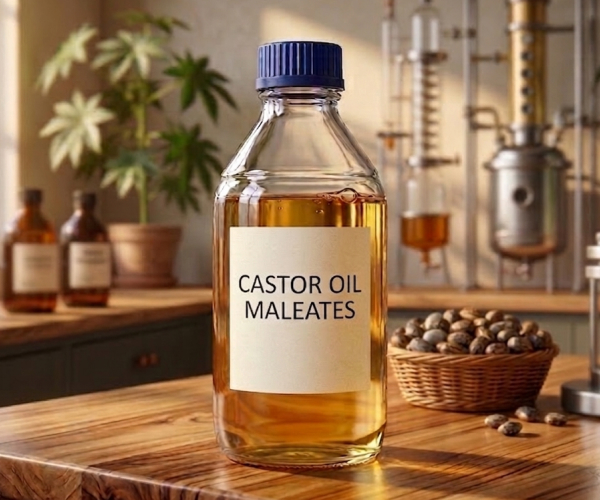
Castor Oil Derivatives
Castor Oil Maleates
- Brand: Nova Industries
- Category: Castor Oil Derivatives
- Sub-Category: Maleate Esters / Reactive Plasticizers & Modifiers
- Compliance Class: Industrial / Coating / Polymer / Plasticizer
- Chemical Type: Castor oil esterified with maleic anhydride – reactive unsaturated ester intermediate
- Grade: Industrial / coating / plasticizer grades
- Physical Form: Amber to dark amber viscous liquid
Product Overview
Castor Oil Maleates are specialty chemical intermediates produced by the reaction of castor oil – or its alcoholysis/glycerolysis products – with maleic anhydride. This maleinization reaction introduces reactive unsaturated maleate half-ester groups into the castor oil triglyceride backbone, fundamentally altering the oil’s reactivity and enabling it to participate in free-radical and thermal polymerization systems.
The resulting castor oil maleate is a reactive, bio-based monomer with acid functionality and unsaturation that can be crosslinked or copolymerized with vinyl monomers such as styrene, methyl methacrylate, and vinyl toluene. This makes castor oil maleates highly valuable as raw materials for unsaturated polyester resins, UV-curable systems, bio-based thermosets, and specialty coatings.
At Nova Industries, castor oil maleates are produced at our Gujarat facility under controlled reaction conditions with verified acid value, viscosity, and unsaturation characteristics. These products serve paint and resin manufacturers, coating chemists, composite material producers, and specialty polymer formulators who require bio-based reactive intermediates with consistent chemical functionality.
Technical Specifications:
| Parameter | Specification / Value |
|---|---|
| Appearance | Viscous Amber Liquid |
| Odour | Mild to characteristic |
| Acid Value | 25 – 35 mg KOH/g (grade-dependent) |
| Saponification Value | 190 – 240 mg KOH/g |
| Hydroxyl Value | 80 – 150 mg KOH/g (grade-dependent) |
| Iodine Value | 60 – 95 g I₂/100g |
| Viscosity (25°C) | 15 – 30 Stokes |
| Specific Gravity (25°C) | 0.960 – 0.995 g/cm³ |
| Moisture Content | Max 0.50% |
| Colour (Gardner) | Max 10 |
| Flash Point | Min 200°C |
| Solubility | Dispersible in Alkaline Water |
What Castor Oil Maleates Do & Buyer Problems They Solve
What They Do:
- Provide a reactive bio-based monomer for polyester and thermoset resin synthesis – castor oil maleates contribute copolymerizable unsaturation to resin formulations, enabling crosslinking with styrene and other vinyl monomers to create thermoset polymer networks with good mechanical and chemical performance.
- Function as chain extenders and crosslinkers in UV-curable systems – the maleate functional groups in castor oil maleates participate in photo-initiated free-radical polymerization, making them useful components in UV-curable coatings, inks, and adhesives where fast cure, low VOC, and bio-based content are desirable.
- Improve coating flexibility and adhesion in alkyd and polyester resin systems – incorporating castor oil maleates into alkyd or unsaturated polyester formulations enhances film flexibility, adhesion to metal and other substrates, and chemical resistance compared to conventional non-reactive castor oil.
Buyer Problems They Solve:
- If your unsaturated polyester resin formulations need a bio-based reactive component to reduce petroleum content and improve sustainability profile – castor oil maleates are direct reactants (not just plasticizers) that participate in the resin network while contributing renewable carbon.
- If your current coating or resin system lacks flexibility or is too brittle after cure – castor oil-based maleates introduce the characteristic flexibility of the ricinoleic acid chain into the polymer network without compromising other film properties.
- If you’re developing UV-curable coatings or inks and need a bio-based reactive diluent with controlled viscosity and unsaturation – castor oil maleates provide controllable reactivity in photo-initiated systems at lower cost than acrylate monomers in some applications.
- If your paint or varnish formulation requires improved drying speed and adhesion – maleated castor oil systems based on DCO/castor oil can be engineered for faster cure and better substrate bonding in alkyd urethane systems.
Key Properties & Performance Characteristics
- Type: Maleate half-ester of castor oil / castor oil alcoholysis products
- Appearance: Amber to dark brown viscous liquid
- Acid Value: Depends on degree of maleinization – typically 60–180 mg KOH/g (grade specific)
- Hydroxyl Value: Variable – residual hydroxyl groups present from castor oil
- Viscosity: Moderate to high viscosity at 25°C – grade and solvent content dependent
- Unsaturation: Maleate C=C functionality enables thermal and free-radical crosslinking
- Reactivity: Copolymerizable with styrene, MMA, vinyl toluene, and acrylate monomers
- Flexibility Contribution: Ricinoleic acid long-chain structure imparts flexibility to crosslinked polymer networks
- Bio-based Carbon Content: High – derived from renewable castor oil feedstock
- Solubility: Soluble in common organic solvents including styrene, acetone, and aromatic solvents
Stability, Shelf Life & Storage
- Shelf Life: 12 months from production date under recommended conditions
- Storage Temperature: 15°C–30°C in a cool, dry, dark environment
- Polymerization Inhibitor: Product contains inhibitor (e.g., hydroquinone) to prevent premature polymerization during storage – store away from heat and direct light which can decompose inhibitors
- Avoid: Peroxides, free-radical initiators, strong oxidizing agents, and heat above 60°C during storage
- Container: Sealed, opaque MS drums or HDPE containers – avoid contact with moisture
- Handling: Handle in well-ventilated areas; product is viscous at ambient temperature and may require warming for easier pumping
Manufacturing & Quality Control
Castor Oil Maleates at Nova Industries are produced through a controlled chemical reaction process:
- Castor Oil Preparation: Refined castor oil or its alcoholysis intermediate (mono/diglycerides from castor oil) used as substrate
- Maleinization Reaction: Controlled addition of maleic anhydride to castor oil under heat with catalyst, producing maleate half-ester groups on the triglyceride
- Inhibitor Addition: Polymerization inhibitor added to prevent premature gelation of the reactive product
- Quality Testing: Acid Value, Viscosity, Colour, Moisture, and Gel Time (in reactive systems) tested per batch
- Process Control: Temperature and reaction time controlled to achieve target acid value and consistent functionality
- Documentation: Batch CoA, MSDS, Technical Data Sheet (TDS), and export compliance documents provided
We're Here to Help
Drop Us a message Today
Share your requirements and our team will get back to you within 24 hours.
why Us
Why Choose Nova Industries?
A few reasons why we insist you to choose Nova Industries are:
-

Fresh & Pure Products
Sourced and processed with care to retain maximum purity and effectiveness.
-

Export-Ready Standards
Fully compliant with international quality norms, ensuring smooth global shipments.
-

Long Shelf Life
Advanced refining and packaging methods keep our products stable and effective for extended periods.
-

Global Supply Capability
Robust infrastructure and logistics support to serve clients worldwide with on-time delivery.
Your Global Partner for Castor Oil Solutions
Get in touch with us for reliable supply, competitive pricing, and export-ready castor oil and derivatives.
Industry Applications & Use Cases
-
Unsaturated Polyester Resins (UPR)
Castor oil maleates are used as reactive bio-based components in the manufacture of unsaturated polyester resins - improving flexibility, elongation at break, and reducing brittleness in cured UPR systems used in composite manufacturing, construction, and boat building.
-
UV-Curable Coatings & Inks
The maleate unsaturation in castor oil maleates enables them to participate in photo-initiated free-radical polymerization. They are used in UV-curable coatings, inks, and adhesives as reactive diluents or oligomeric components that contribute bio-based content, flexibility, and adhesion to the cured film.

-
Alkyd & Alkyd-Urethane Resins
Maleated castor oil is incorporated into alkyd and alkyd-urethane resin formulations to improve drying speed, adhesion, and chemical resistance. The maleate functionality enables crosslinking with isocyanates and co-polymerization with other resin components, giving paint and varnish manufacturers better performance profiles.

-
Thermoset Composites & Laminates
Used as a bio-based reactive monomer in thermoset resin systems for fibre-reinforced composites. Castor oil maleates can be copolymerized with styrene to produce resins with improved flexibility and impact resistance compared to pure phthalic anhydride-based UPR.

-
Adhesives & Structural Bonding
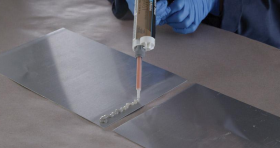
Used in reactive adhesive formulations where controlled crosslinking, good adhesion to multiple substrates, and bio-based content are required. Castor oil maleate-based adhesives offer the combination of flexibility and strength needed in assembly, packaging, and structural bonding applications.
-
Specialty Coatings & Surface Protection
Used in specialty coating formulations for industrial surfaces, metal protection, and chemical-resistant linings. The castor oil backbone contributes flexibility and film toughness while the maleate groups enable reactive crosslinking for improved chemical and solvent resistance.

FAQ’s
Frequently Asked Questions (FAQs)
Castor Oil Maleates are reactive derivatives used as plasticizers and modifiers in PVC, coatings, and specialty resin systems. They improve flexibility, heat stability, and adhesion in polymer formulations.
Yes, samples along with TDS, SDS, and COA are available upon request.
Testimonials
valuable words from our client
We have been sourcing Hydrogenated Castor Oil and 12HSA from Nova Industries for over three years. Their product consistency and batch quality are highly reliable, which is critical for our manufacturing process. Deliveries are always on time, and their team is very responsive.
Nova Industries stands out for their professionalism and technical understanding. The quality of their castor oil derivatives meets international standards, and their documentation and export support make global sourcing seamless for us.
What we value most is Nova’s consistency and transparency. From inquiry to shipment, the process is smooth and well-managed. Their castor oil grades perform exactly as specified, helping us maintain product quality across our production lines.